
In this Long Read
Below is a compilation of blog posts I wrote when we were in Grenada. We spent a lot of time in Grenada and visited almost every year from 2017–2021 when we decided to cross the Pacific.
Grenada is a popular spot, particularly during hurricane season, from June 1 to November 30th. If we had to visit just one place in the Caribbean, Grenada would be a top contender.
Grenada Hash House Harriers – a walk or a run for everyone
Originally posted July 3, 2017
This past Saturday our family walked a 3-mile loop with the Grenada Hash House Harriers (HHH). Being July 1, it was Canada Day. We were amongst a mix of local people and cruisers. As far as we know, the Canadian cruising families that participated in the hash include “SV Pinocchio” from Quebec City, “SV Maple” from Vancouver, and our family on “SV Aphrodite” from Ottawa. Canada is well-represented in the Caribbean. There were likely some other cruisers or expats that were at the hash. We just haven’t met them yet.
The HHH self-describes as a “drinking group with a running problem.” Chapters of the HHH can be found worldwide. We had a lot of fun at our hash, and got very muddy. It was a great opportunity to get some exercise, and connect with local people and other cruisers.
To be clear, you can walk or run a hash. The Grenada HHH group seems to emphasize camaraderie and having fun. The cost to participate was roughly $3 US. That price covered our entire family of six.
There were about 250 people at our hash, which I understand is a typical turnout for Grenada HHH. There were people of all body types and fitness levels. Interestingly, I didn’t see a single person stretch their quads or do a side lunge, ever.
Anyway, the hash began with a man on a microphone who gave some direction to hash “virgins”; that is, people who are new to hashing. As part of the starting formalities, one man drank beer from his shoe – such is the rule for someone who brings new shoes to a hash.
[wpvideo nUJumLGn]
I had some concerns that one of our kids would fall, or cause a sit-down scene during the hash. Our kids are 11, 9, and 6-year old twins.
As any parent knows, sometimes even a small abrasion can be a major setback and can add unwanted drama. I’ll spare you the stories, but we’ve hiked on more than one occasion with a whining child. It isn’t pretty.
It turns out my fears were unfounded.

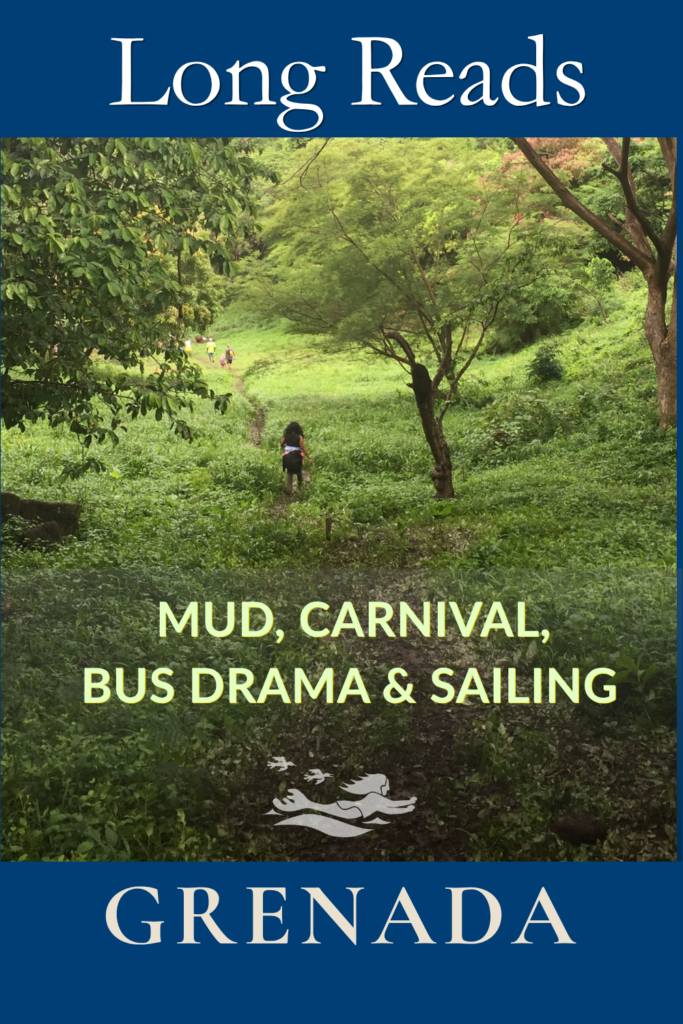
The hash was more strenuous and tricky than I had expected, but it afforded us some amazing views.


Some people wore gloves to help them to grip tree branches as we skated down steep, muddy tracks.

Most people at the hash wore hiking boots, runners or cross trainers. My husband, Rick, wore his boat shoes. The boat shoes proved to be very slippery but Rick managed to keep his balance without falling once.
Rick tends to excel at all things athletic. In contrast, I have a lot of inner conversation before committing to a throw. Given our experience over the past two years sailing on our catamaran, I should write a book called, “Building marital synergies: one line toss at a time”.
Back to the hash. The hash organizers plan the hash routes a week or two in advance. They talk to homeowners and request permission if they want to cross properties. Just prior to the hash, they mark the hash route using colourful bunches of shredded paper.

A hash organizer told me the trails start off quite nicely but the routes quickly deteriorate through use and because we’ve had some rain. By the time I had arrived the trail had been trampled by about 246 people ahead of me.
At the steepest and muddiest part of the trail, an Australian couple turned back. They joked that they had “seen this all before”. It seemed they were not interested in a muddy hike.
Another Canadian cruiser from Quebec, however, pressed on. Her name is Johanne. What makes Johanne’s story so remarkable is that she and her husband, Marcus, have seven young kids. All nine of them live aboard their ketch (that’s a boat with two masts). As I’ve said, their boat is called “SV Pinocchio“. They have crossed the Atlantic twice. Their family plans to circumnavigate.
Johanne brought four of her children to the hash, including her one-year-old daughter Florence.


Florence rode in a colourful, Canadian-made Chimparoo brand carrier, and fell asleep during the hash.
Parts of the trail were less treacherous and quite lush and scenic.


The rain added to the slick terrain. But, the organizers were really helpful. I fell once as I tried to run across a steep bank. One of my legs slid down a slope. It turns out it was better to walk along the valley.

We didn’t see three of our kids until the hash was over. Betty (11), Paul (9) and Henry (6) had raced ahead – providing me with great motivation to push forward. Rick and I walked with Karen (6).
Our kids walked the entire route with Janet from “SV Maple” and her two young daughters. Their family owns a Leopard 38 catamaran. Janet and her husband, Darryl, bought their boat in Albania and sailed her across the Atlantic to the Caribbean.
I really enjoy meeting other cruising families. I am always amazed to meet people who have crossed oceans with their children.
Anyway, after two hours, Rick, Karen and I had finished the hash. We were reunited with our kids and the other hashers. It was time to wash off.


People enjoyed some well-deserved beer. A DJ provided a little music for dancing.
Later, on the bus ride back to the dinghy dock, Henry (6) told me that he had felt tired during the hash but he just kept walking. I liked his optimism, and was pleased to hear that all of my kids did very well and had energy to spare. I am looking forward to participating in another hash. It is a great way to get fit. And, it allowed us to see parts of the island of Grenada that we would otherwise never see.
Sights to See (and Unsee) at Grenada Carnival 2017
Originally posted August 16, 2017
We were walking single-file, up a hill. Our kids were in the lead. Suddenly, our progress was stopped by what my kids now refer to as “the hold up”. It was an arresting sight. And, a quick-thinking parent would have responded to my kids’ immediate questions with, “Dancing. I guess they were dancing.” End of.
Instead, our kids stood gobsmacked as a fleshy woman in a carnival outfit danced with one leg hoisted in the air by her smiling partner. Gyrations sent her body into convulsions, with only the tiniest piece of fabric straining to cover her modesty.
The scene caused much delight amongst my children. They thought it was wildly funny. And, I cringed later as they danced on our boat and exchanged wedgies.
We are traveling on our catamaran, homeschooling our kids and exposing our children to cultures. This was our first time at Grenadian Carnival 2017.


Carnival spans many days, and involves lots of different events. This blog post is about our time at the Parade of the Bands.
The Parade of the Bands had a marvellously disorganized and organic feeling to it. Police monitored the area, but no one was particularly policing the route. In fact, we saw a parade truck back up into the crowds and no one seemed the least bit bothered.
People seemed to arrive and participate in the parade when and where they were ready.

Loud, deafening music emanated from trucks of people who managed the music. I’d call them DJs but the Soca music delivery seems to be more creative than just spinning discs.
Groups of folks surveyed the parade from the top levels of the music trucks. The top-level folks tended to be attractive, and danced sporadically. The sun was shining but they aptly recreated the atmosphere of a nightclub.
Grenadian Carnival does not seem to discriminate based on age or body type. Sure, there were people with buff bodies and tiny costumes. But, there were modest outfits too. Carnival is for everyone.
I liked the mixtures of people. Older men wheeled carts carrying the steel drum sets for younger drummers.

I enjoyed watching mothers be mothers in full feathered resplendence as they ushered their kids along the parade route, some of whom were in costumes themselves.

I marvelled that a group of thirty or so women could arrive at one outfit to wear in a parade. Grenada must be a culture with fabulously collaborative bridesmaids. One group of women seemed to be 65 years or older. They danced and rocked glittering gold bodysuits.
Along the parade route, our children found glittering jewels and stray, colourful ostrich feathers.


Later, back on our boat, my nine-year old son held blue teardrop jewels to his chest, affecting pasties. At supper, my six-year olds danced in their underpants like Sumo wrestlers. Of course, we asked them to stop. (Parenting guides just don’t address these scenarios.)
This morning the tone on our boat is more muted. My kids are focused on playing carnival. And, they are operating a swift trade with their found treasures. So far, there have been only few fallouts about necklaces.
Grenadian Carnival exposed us to a slice of Caribbean culture that is so important to its people. One local man told me that the celebration is “bigger than Christmas”. He was Rastafarian and I later wondered if he celebrated Christmas. (They do, but on January 7th.)
I’m learning so much on our travels.
When my kids reflect back on their childhood I wonder what they will remember.


Drama on the Bus in Grenada
Originally posted August 18, 2017
With venom rising in her throat, a woman picked up her long hair, setting her dark braids in motion. “Don’ be expectin’ me to pay dis fare when yuh ha inconvenienced me in dis way.” Sitting next to her was a young boy who bobbed and jerked his head to stare at the passing village.
Another, older woman from the back of the bus chimed in. “I ha my rights and yuh ha yuhr rights.” The bus driver waved his hand in protest and kept driving. A slightly bemused look crossed his face, visible to me in the rear view mirror.
The older woman was incensed. We had taken a three-minute detour without notice and our bus driver had received a tip. The gloves were off. With the younger woman still twitching and smoothing her hair at the front of the bus, the older woman let the bus driver have it, ” I’m gonna pull yuhr intestines out through yuhr nostrils. Bitch.”
“Momma,” my daughter Karen whispered. I looked back to see her. “That lady just said the B-word”.
The bus drove in silence for about five minutes. Then, the driver stopped and let the two women out along with the young boy. Little was said. And, no fare was requested or offered. On the bus went.
I enjoy taking the public bus in Grenada. Bus #2 takes us from the village of Woburn through twisty roads, past small enclaves, across green hills, around harbours, and past random goats until we reach the central city of St. George’s.
In St. George’s, we can buy groceries, fresh produce, clothing, shoes, spices, and marine supplies. We can also visit the library. Some of the market vendors are very friendly, and recognize our family. There’s an authenticity and warmth amongst the vendors that goes well beyond a public relations act involving cabbage and mangoes.


But, to stay on track, I will write about St. George’s market, the amazingly fresh cinnamon, and my strategies for haggling another time.
This blog post is about Grenadian buses. The buses are small, passenger utility vans with five rows of bench seats. To the best of my knowledge, I have not been on a Grenadian bus with air conditioning. When it rains, and the windows are shut, it can be stifling.
Passengers ride next to the driver, on the bench seats, and in fold-out seats in the aisles. Children often sit on laps. Our family of six can compress onto a single bench seat if necessary. On one occasion, I have been on a bus that was carrying 24 people.


The buses play music, often soca music, sometimes at deafening levels. Today was unusual because the driver (and all the passengers) were listening to a sermon about Jesus giving sight to the blind.
The driver is usually accompanied by a man who scouts for passengers, and collects fares. There are some bus stops. But, basically, anyone who appears to be waiting anywhere on the route is fair game to be honked or shouted at for business. To exit the bus you knock on the ceiling and the driver usually stops immediately. Much like a crowded elevator, sometimes people have to get off the bus to let other people out.
I could tell you about the mothers on the bus, or the gorgeous hairstyles, or the helpful people who have offered to sit with my bags in the bus. But, no. I’d like to tell you about the things that you just don’t see in our hometown of Ottawa, Canada.
The best example would be the man who got on the bus with a chainsaw with no protective cover. The entire chain blade was exposed. He sat at the front of the bus, in the middle seat, right next to the bus driver. Then there was the man who I sat beside, a manspreader, who slung his arm about our seat, while casually drinking an open beer.
What about the drama that I bring to a bus in Grenada?
I usually carry at least two large shopping bags. My challenge is to compress myself and my kids without losing a tin can or bag of potatoes. And my children, darlings that they are, travel like any other kids when they are crammed together with no seat belts. They like to feel the wind in their faces. And, while I haven’t yet complained to a driver about taking detours, I have been known to say “Get off your brother,” and “Arms in please!”
Passage to Grenada from Trinidad
Originally posted January 30, 2018. This is an excerpt from a blog post called Leaving Trinidad for Grenada with Svetlana
“I can see land!” Henry said, excitedly. Reef appeared on our chart plotter, extending well beyond the southern tip of Grenada. In a way, it felt like we were coming home.
The water here is aqua. We are anchored amongst super yachts, and other cruising boats. Already, our kids have spent hours swimming in the water. After spending three months virtually unfettered in the boatyard, our kids have had to relearn the rules of the boat. Paul, for example, jumped off the roof into the water without permission or adult supervision. I don’t like this activity at the best of times. I worry that he will take out a sibling or hurt himself on the back transom.
We have now caught up on sleep. I’m buying some medicine here as it is literally ten times cheaper to buy in Grenada than in Trinidad. It feels great to be back in Grenada and walking in familiar territory.
Lana has now joined up with a race boat in Grenada called Monster Project. I was given a tour of the boat today and it was pure, carbon-fibre, adrenaline-filled fantastic. Lana will be sailing with another boat for Grenada Sailing Week 2018, and then she’ll sail with Monster Project to Antigua in early February.
We will be leaving for the Bahamas in the next few days. The report about Lana’s encounter with pirates is posted on the Caribbean Safety and Security website.
800 nautical miles from Grenada to Haiti
Originally posted February 16, 2018
It’s early morning on Tuesday, February 6th, and I am drinking coffee. “According to Chris Parker…” my husband says as he looks at his phone. “…the gradient will be lightest…” he continues to read. And, while I am barely sentient I am thinking ‘lightest’ sounds good, and ‘gradient’ is a pretty innocuous word. He reads on, “possibly gusting to….“ and I am listening and in a happy place until I hear “…over gale force.”
Gale force? The two words stop me in my tracks. “Gusting over gale force?” I say. “What? Why are we even having this conversation?” I sit up, inspect my coffee cup before setting it firmly on the table. We’re not going; there’s no way.
I knew we were leaving Grenada, but the decision to stop in Haiti or to go directly to Great Inagua in the Bahamas had been a talking point between my husband and I for several days.
In talking with Chris Parker, the Florida-based weather router, we felt the ideal day for us to leave was Monday, February 5th. But, we were delayed by a full day and were starting to see some bad weather approaching our route.
Being a full day too late, I was thinking I am not putting my family through this, not racing across a raging Caribbean Sea. Even salty sailor Jimmy Cornell says to avoid sailing across the Caribbean Sea in the winter months.
Rick continued in a quiet measured tone. “[Chris is] using the word ‘Gale’ specifically to refer to winds between 34-47 knots. We’ve been in that kind of weather before.”
He pulls out his computer and shows me charts from PassageWeather and diagrams of waves. The waves look peaceful near Grenada and then become larger on our approach to Haiti. “Looking at this,” he says, “the waves will be between 3 and 4 meters, maybe 5 meters, for a short while, and then we’ll be in calmer waters south of Haiti.”
I was conflicted. If we stayed any longer in Grenada we might have to bypass Haiti altogether. I really wanted to see Haiti. Aphrodite is a sturdy blue water catamaran. It’s fast and safe and has been sailed by others in over 60 knots of wind – a passage described in the last few paragraphs of this magazine article.
The incoming foul weather would have kept us in Grenada for at least two weeks. My position was revisited, revised and revisited some more. Rick quietly went about his day. At 5 p.m., the decision was made. I rushed to customs by taxi and we were cleared to leave Grenada.
I was pumped, and worked quickly to raise the anchor. This would be my first ‘longish’ passage. We expected that the passage from Grenada to Haiti would be a continuous four or five night sail. Being cautious, we sailed with a third reef in the mainsail. Sometimes we sailed under headsail only. Other times we sailed using only the mainsail. On one occasion we dropped the sails and motored. Safety was topmost in our minds.

En route, Chris Parker had predicted over SSB radio that we were in for a “wild ride”. Three days later, as I sat jostled by waves taller than our boat, spray crashing around me and into the cockpit, I thought that perhaps sailing wasn’t for me.
While I was lamenting my state as a failed salty sailor, as well as our predicament in pounding waves, my husband assured me, “We’ll be out of this in about 30 miles, and at this speed…” For God sakes, we were going around 6 knots. That meant that we were about to endure five more hours of big waves.
We had planned for this sort of weather. Rick had rigged our Fiorentino parachute sea anchor. The sea anchor fans out and provides stability and ‘stoppage’ in rough, offshore situations. Although the sea anchor was ready to use we didn’t come close to needing it.
The kids and I had secured cabinets, and cleaned up to prevent our belongings from flying around our boat in rough weather.
But, when our 70 lb ice cream maker threatened to jump from the galley counter, and our 12-year old, Betty, was holding it to prevent its fall, and a Melamine platter of a fresh-from-a-summer-camp-in-the-1960s vintage fell from a stack of plates and cracked, I began to do some more rearranging. A heavy 12-volt transformer had already fallen to the floor of the galley.
A Nalgene water bottle was a quick casualty. The top of the bottle cracked away from the lid. I held it up for my husband to see. “Is that thing under warranty?” he asked as he returned his gaze to the foaming sea. He is a thinker and a planner and seemed to be unfazed by the rough waves.
The waves were amazing and forceful. I felt like I was being lifted by an overly aggressive dance partner, putting his muscles on full display. Again, and again we were lifted. The waves wobbled and ripped under our boat. Being a catamaran, our boat lifted up on one side and then the other. Sitting at the helm for hours I envisioned that a swiveling plastic hula girl would be wildly entertaining. That’s what happens when I operate on a few hours of sleep.

I put my head outside for a minute and felt the waves and the wind bead together in my hair.
I will take a moment to describe how we got from calm, smooth seas to an atmosphere of awe and trepidation. On the first day, my husband sat at the helm, sleeping in bits and pieces. I baked bread. I even made a chocolate cake. We saw a tanker and altered course to pass behind it.


By day two, signs of sleep deprivation began. My husband slept during the day. While waves tossed about the boat, shuddering over the bow, my husband slept under a blanket. Water pounded over the trampolines and still he slept. Yet, at some point, he must have decided it was hot. And, perhaps he forgot he was on a sailboat in rough weather. He doesn’t remember doing this, but he seemed to have opened the hatch above his head. Perhaps a breeze fluttered across his cheek. All was well until a 10 foot wave saw an opportunity and pounced, right into the master berth.
The water temperature measured a balmy 24.9 degrees Celsius. I was watching the water temperature gauge at the helm. Surely it wasn’t that cold when salt water cascaded through the hatch and onto our bed, soaking my husband, our queen-sized mattress and all the bedding. Naturally, the water didn’t stop there.
Water fell onto the floor. Towels were used to mop up the water. Mounds of wet laundry were placed in one of our bathtubs, where the smell of wet mushrooms would fester and ferment for the remainder of our trip.
We hauled the mattress to the cockpit, and briefly discussed whether ammonia would remove the salt. I indicated that ammonia wouldn’t work as “matter could not be created or destroyed,” prompting my husband to utter “no” and something about “atoms” and “molecules”.

Meanwhile our kids were listening to this ridiculous banter, and were now convinced that their parents were raging idiots.
At this point, the rollicking games I had envisioned, the crafts, and the quiet reflective moments that I had hoped to share with my children on the passage were gone. Instead, we ate leftover bread, and fruit out of tin cans. My kids used electronic devices, computers, an iPad, cell phones, you name it.
I’m not going to make excuses or apologize. The sea was rough. I don’t own a blender, or a hand mixer, but if we did, I would have plugged those into every wall socket that we own and my kids could have used those gadgets to mix things – anything, even old crayons – as a form of distraction and entertainment.
Meanwhile, my husband was thinking about Haiti and wondered whether we might have something to offer people as gifts. We have some Canadian lapel pins. Not really thinking, I suggested I could make donuts. “Cookies would be better, I think,” he said.
Think again, mister, I thought. My inner soul-sister was awakened and said something curt about the 1950s. The subject of cookie making was dropped, and has not been revisited.
By day 4, we were seeing land. Cape Pointy Bit on the south coast of the Dominican Republic helped to ease the waves that had threatened us on the broadside. We kept sailing and were excited to have our destination within our grasp. At one point, Paul and Rick fiddled with the mainsail. Paul spotted a large shark and was thrilled.
But, as darkness fell my husband saw lights from another boat on our port side. The boat didn’t seem to waver. We sailed, and they kept pace.

In hindsight, I should not have asked whether the other boat was following us. Betty heard me talking to Rick. My words caused her concern and now this moment will be forever emblazoned on our kids’ memories as the-time-we-thought-we-saw-pirates.
We reassured our kids that everything was fine. Meanwhile, I sat in the head with our flare gun, discreetly reading about how to use our flare gun. We turned off all of our lights. We disabled our AIS system, which provides other boats with greater detail about our boat such as length, boat name, speed, GPS position, etc.
The “pirates” paralleled our course for about six hours always staying four miles off our port side. With a sufficient lack of sleep those pirates didn’t bother me at all. In the dark, I watched from the helm with a strong coffee while enjoying a delicious re-read of a Canadian novel about a barbershop. Canada’s literary landscape is so much broader than topics like dark woods and pines.
At daybreak, our pirates were definitely gone. We were in sheltered waters. We spotted bottles glinting on the surface of the water. Upon closer examination, these floating items seemed to be marking fish traps. Rick steered to avoid them.


About eight dolphins put on a good show under our bow. Karen thoroughly inspected a flying fish that had washed onto our boat.
We are now in Haiti. In talking about the passage later, my husband said that 3-4 meter waves and strong, sustained winds was a good experience.
Dammit, if I don’t think he’s right! How Rick convinced me to ride the waves offshore to Haiti is partly a negotiation on his part, and partly my desire for adventure.
Lorraine Escher
SV Aphrodite
Ile a Vache, Haiti


COVID Arrives in Grenada
Originally posted September 11, 2021
After enjoying more than a year of safety, COVID has hit the island of Grenada. As of late July, Grenada had suffered one COVID-19 death and there were only four active cases, all imported, which likely meant that COVID had been brought by tourists. That all changed in August. As of this blog post – just over a month later, 1760 people have COVID and 22 people have died from it. The numbers are climbing every day.
Grenadian Health Minister Nicholas Steele wept as he spoke of the first death that began this recent wave of the pandemic. One of his colleagues praised him for his show of strength. In an address last week, Prime Minister Mitchell said that more deaths will follow. The Ministry of Health is working relentlessly to get Grenada vaccinated.
The stats for Grenada on July 30, 2021 are shown in the table below, taken from the local news site, www.NowGrenada.com.
| LOCAL (CURRENTLY) | |
| New positive case(s) | 0 |
| Active cases | 4 |
| • Imported | 4 |
| • Local | 0 |
| Hospitalised | 0 |
| In self-isolation | 4 |
| In quarantine facilities | 715* |
Contrast that with data from yesterday, September 10, 2021.
| LOCAL (CURRENTLY) | |
| New positive case(s) | 216 |
| Active cases | 1,760 |
| • Imported | 9 |
| • Import-related | 0 |
| • Local | 1,751 |
| Hospitalised | 56 |
| In self-isolation | 1,760 |
| In quarantine facilities | 554 |
The total population of Grenada is 112,523. Grenada now, unfortunately, leads the world for COVID per capita. It is hard to see how this stops.

We are staying as safe as we can, becoming virtual hermits as we socially distance. A few weeks ago, we moved our boat to Prickly Bay. We are anchored at the mouth of the harbour, all by ourselves, like our own island. In Calvigny Cut, we were in the thick of things. We were within easy distance of lots of other families afloat. While we really enjoyed their company, the continuous social activities and playdates were starting to impact our homeschooling. In contrast, Prickly Bay has a large number of boats but very few children. Our decision to move our boat happened to coincide with the spread of COVID on the island.
Fearing a lockdown, and to stay off the island itself, I bought about a month’s worth of groceries and began freezing vegetables. In the grocery store, my intentions were laid out like a badge of shame. Purchasing toilet paper felt like the mark of selfish hoarderism. Six gleaming white, medical-grade, KN-95 masks felt like trophies. In Grenada, a KN-95 mask costs three times the price of a fabric mask.
As I listened to the Right Honorable Dr. Keith Mitchell Prime Minister of Grenada speaking last week, I wondered about the old lady in St. George’s who sells fresh bay leaves at $2 a bag. I thought about the shop employees who serve hundreds of customers a day. They are exposed to anti-vax attitudes, noses and stray viruses.
Meanwhile, I’m nearly cowering on-shore in my white medical-grade mask during the shortest of visits away from my floating oasis that is our catamaran, SV Aphrodite. I wonder about the two homeless men who lounge shirtless on the sidewalk near the central market.
I took Joel’s grocery bus last Saturday. Joel is a private taxi driver with a mini-van (most of the taxis here are mini-vans). He picks up cruisers at the Budget Marine boat dock on Saturday mornings to go grocery shopping and charges $15EC/person ($5.56 US) for the round trip. Joel is vaccinated and he allows vaccinated passengers only.
At the time, the local bus company was still in operation. But, hand and bus sanitizing stopped long ago. Some bus drivers continued to decorate their buses with little bottles of sanitizer dangling from all the headrests that seem to swing in time to the local music. Mask wearing had become much more lax than when we arrived on the island in July 2020.

A few days ago, the bus service officially disbanded due to health and safety concerns. However, I’m told that some bus drivers continue to operate on most routes. I should mention that, to avoid the bus, our family walked 2.5 hours to get to town and be vaccinated. I recognize that some people are not so fortunate as to have the time or abilities to walk the route. Grenada is a very hot, humid and hilly country with narrow, winding roads. In large part, Grenadians must stay at home or find alternative ways to travel. This weekend, (September 9 at 5 PM to September 12 at 5 AM) the Grenadian government has issued a stay-at-home order. Everyone is confined to their immediate residences, which, for us, means our boat. The only allowable reasons to leave your residence are for medical emergencies, or if you are being tested or vaccinated for COVID. This weekend we won’t snorkel at a nearby reef, kayak, or go to shore. The Internet gives us daily updates as to the horror that is unfolding on shore. Specifically, on Facebook, I follow the GIS – Government Information Service of Grenada, which issues frequent updates.
During the week, essential workers like grocery store staff and construction workers are allowed to go to work. Likewise, we can go to shore to buy food, water and take-out food. Restaurants are closed to dine-in service.
Grenada began vaccinating the public with AstraZeneca in February 2021. The Pfizer vaccine was introduced in late August 2021. But, as you can see from this image, the uptake for vaccinations has been slow.

Many people in Grenada (and beyond) are skeptical of the vaccine. From my observations the reasons, in Grenada, include faith over science, rejection of modern medicine, and peer pressure.
Faith in God is a current that runs through Grenada, and is invoked even in government addresses. That is not to say that all Grenadians put faith over science. However, I observed one determined elder refuse to use hand sanitizer. Raising her eyes to the sky and putting a sturdy leg in the bus, she declared with confident vibrato, “Gawwd will protect me.”
Grenada has a strong and diverse medical community. There is a large medical university on the island. However, some local people put faith in good food and bush medicine. (Some cruisers do too for that matter.)
Strong herbal brews are popular remedies for everything from dengue to menstrual cramps. The Grenadian government doesn’t discount these attitudes and encourages people to eat well. However, the government wants people to get vaccinated. A few months ago, a man asked me “Are you enjoying your science experiment?” as we rattled down a road in his truck. (I was hitching a ride for convenience. It’s friendly like that in Grenada.) He told me that he preferred to eat his vegetables, enjoy fresh air, and stay away from the vaccine.
Further, there is a sentiment among some people that Grenadians will not be used as a medical testing ground. Amongst a population that is largely black, I have heard mutterings on buses, and in the street, about a historical distrust in the newly developed vaccines. Indeed, on a Duke University Research website, Cydney Livingston describes a litany of instances where black people have been used without consent or knowledge for medical research. It makes for a sobering read.
Finally, despite many efforts and ad campaigns throughout the island, there will always be pockets of people susceptible to peer pressure. On a recent bus ride, I was shocked to hear the lyrics to the Jamaican artist, Sizzla Kalonji’s, ”No Vaccine” protest song. Kalonji likens the vaccine to a form of slavery. When watching young men rock to the beat of this song, the message seems unforgivable.
The number of people getting vaccinated in Grenada is growing by the day, albeit slowly. Recently, when I visited the St. George’s Medical Office, there were several young people waiting their turn to get vaccinated.
The Grenadian health team has been quick to set up COVID wards with beds for those who need them. These are pictures from the GIS Facebook page.


Our experience at the hospital shows that the people are committed but the conditions are different from what we would expect in Canada. I know this because, a few months ago, Paul spent two nights at the hospital. He had emergency appendix surgery. His surgeon was amazing. The nurses at the hospital work very hard, and made efforts to make Paul feel comfortable. Two pigeons walked the ward.
I’m buoyed up to see that the vaccination numbers are rising – but it’s slow. Right now, people are working hard to control the hell that has gripped this tropical paradise.
As for our plans, we intend to stay in Grenada at least until the end of hurricane season in November. We might head to Panama for Christmas, then cross the canal in January and hopefully sail to French Polynesia or Fiji in the late winter.

Thanks for reading!
Pin it
You can save this content to your own Pinterest board using the image below. Thanks for reading!